
Abstract submission
Contribute to shaping the future of dermatology and venereology during the 2026 EADV Congress in Vienna.
Standard Abstract submissions are closed
Abstract submissions
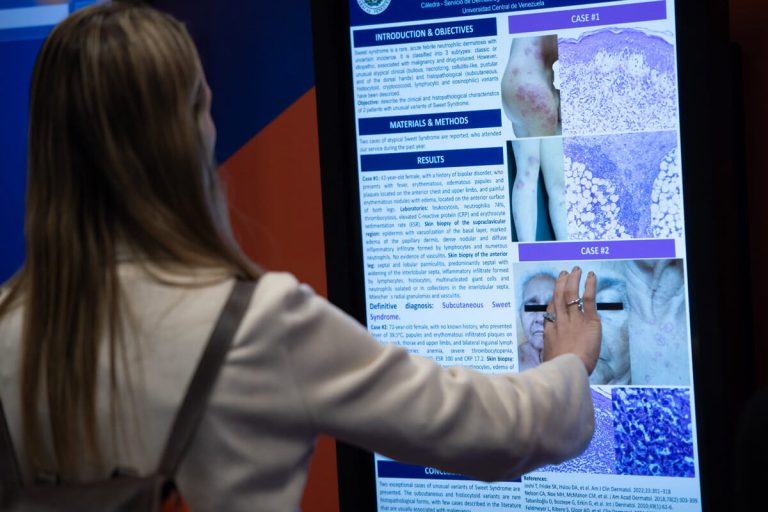
Multiple abstracts are accepted and may be chosen for an oral presentation or a digital ePoster, contributing to the extensive scientific programme of EADV Congress.
Abstract submission deadlines
- Abstract submissions opening 12 March 2026
- Abstract submissions closing 27 April 2026
- Abstract evaluation notification 21 July 2026
- ePoster submission opening 4 August 2026
- ePoster submission closing 21 September 2026
How to prepare and submit your abstract
Please be aware that two submission options will be activated for EADV Congress, one dedicated to clinical cases and the other for general abstract submissions.
Both submission types will allow authors to select between two presentation type preferences: ePoster or oral presentation (see below paragraph for more details).
To correctly submit your abstract, you must use and fill in the HTML fields available on the submission platform. If your abstract does not include one or more of the sections listed in the “Abstract Body” step of the submission, please leave those fields empty so they will not appear in the final abstract.
A maximum of one file (.jpg, .gif, .png, or .bmp) may be uploaded as an attachment to each abstract section. This file can include one or multiple table/ images. Please remember to include details about the image(s), such as figure note(s) or reference(s), in the dedicated field located directly below the file‑upload section.
When submitting an abstract, the data of the author set as Presenting author must include a valid email contact. In case of abstract acceptance, this contact will be used to notify the instructions and requirements for the preparation of the ePoster/ oral presentation.
When submitting an abstract, you will be asked two important questions for internal monitoring purpose:
- Was your abstract presented/ published in previous occasions (being classifiable as “encore” abstract)?
- Are you submitting an abstract involving collaborations with Industry?
Additional abstract requirements:
- Abstracts must be submitted in English.
- The abstract title should not be written entirely in capital letters.
- The size of the abstract is limited to 4,000 characters (spaces included).
Please note that the submission program will automatically calculate the size of your abstract and will not allow submissions that do not fit in the size requirements.
- Please be informed that the abstract title is free of character number limitation.
- Tables and figures (graphs) are allowed, and they are not taken into consideration for the character count limit.
- Pictures of patients and body parts are NOT allowed for inclusion in the abstract body. Abstract containing these kinds of pictures will be rejected.
- No identifying features such as names of hospitals, medical schools, clinics, or cities may be listed in the title or text of the abstract. Do not include the names of authors either. Their names and affiliations (institutions) will be registered separately when submitting the abstract online.
- Check spelling and grammar carefully. Direct reproduction from your electronically submitted abstract text means that any errors in spelling, grammar or scientific data will be reproduced as submitted.
- Use generic names. The use of commercial drug names, brands and registered trademarks is strictly prohibited. Drugs should be referred to by the active substance or pharmacological designation.
- No mention of pharmaceutical company names should be included in the abstract.
During submission, you will be asked on whether your abstract should be preferentially considered for:
- ePoster (digital-only, not requiring Author’s physical attendance to the event, to be displayed during the event and on-demand)
- Oral presentation (requires live attendance to the event and oral speech from the presenting author)
If an abstract is submitted with preference for an “Oral presentation”, after the review process, the abstract submitter will be notified on one of the following possible outcomes:
- If the submitter receives an acceptance confirmation with details for an oral presentation (including details on date and time of the session), this means that your abstract was accepted according to your preference.
- If the submitter receives a digital ePoster acceptance confirmation, this means that, even though the abstract was not selected for an oral presentation, it is given the opportunity to be displayed as an ePoster (digital-only) in a dedicated area of the Congress Venue (ePoster area).
If the submitter receives a rejection confirmation, this means that the final score of the submission did not reach the minimum acceptance threshold. In this case, authors are not entitled neither to submit an oral presentation, nor an ePoster.
Evaluation and scoring
The evaluation and scoring of the abstract (acceptance as ePoster or as oral presentation, or rejection) will be made according to several criteria, including:
- Is the content interesting, informative, novel or important?
- Are the methods valid, the results relevant and the conclusions justified by the data?
- Is the data presented with clarity and with appropriate structure?
- Is the text written according to proper English grammar and syntactic style?
Copyright and publication of abstracts
Submission of an abstract implies that it has been approved by all listed authors.
The EADV Scientific Programming Committee reserves the right to make the final decision concerning the form of presentation.
As part of the submission, the author grants EADV the exclusive right to first publish the abstract, and thereafter a non-exclusive right to publish, reproduce, distribute, display and store the abstract worldwide in all forms (including on the EADV website), formats and media now known or as developed in the future, including print, electronic and digital forms. For the avoidance of doubt, “electronic and digital forms” shall include but shall not be limited to databases, USB and forms accessible via electronic and digital networks, wireless transmission and communication systems.
The author also grants EADV the exclusive right to retain income resulting from the above-mentioned publications by EADV. No fee shall be paid to the author by EADV for the license granted herein.
The author will retain copyright of his or her abstract, including the pertaining moral rights. However, the author shall only reuse, reproduce or post the abstract with acknowledgment to the initial and first publication or presentation at an EADV event, and therefore reference the name of the EADV event and the date.
The License of Copyright Use between EADV and the author is governed and construed in accordance with the laws of Switzerland.
Accepted abstracts will be published here.
Media & Embargo Policy
Please see the below extract from the 2026 Congress Media & Embargo Policy:
Every abstract author and meeting attendee, whether from the media, companies, institutions, organisations, universities, investment advisors, or any other category, must adhere to the embargo policy.
Prior publication
If the abstract is also submitted as a manuscript for publication, authors are responsible for coordinating a publication date that abides by the embargo policy. If publication occurs online or in print before the specific embargo date and time set by the EADV, the abstract must be withdrawn or presented as an encore.
Encore abstracts
Please consider that it is possible to submit abstracts already published or presented in previous events. The submission procedure to be followed is the same of newly released abstracts; the required step is to reply “YES” when asked about previous presentation/ publication of the abstract content.
In case of abstracts published after submission to the EADV and before the embargo lifting date, they must be declared as encores in the relevant ePoster or presentation. In addition, an email must be sent to [email protected], to include this information in the original submission.
Embargo dates and time
All abstracts:
The embargo is lifted at 7:00 AM CEST on 30 September 2026. After this date, abstracts will be published on the EADV Event platform and become accessible to registered participants.
Industry abstracts:
The embargo is lifted at 7:00 AM CEST on 30 September 2026. After this date, abstracts will be published on the EADV Event platform and become accessible to registered participants.
Before this date, only top-line content (no results or data) can be disclosed to announce the session content, learning outcomes and speakers.
Please be informed that the above embargo dates and times are not applicable to “encore” abstracts, that is abstracts previously published/ presented before their submission date.
ePosters requirements
Only the authors selected as “Presenting author” during abstract submission will be enabled to upload the ePoster by logging in to their account. The ePoster submission link will be also sent to them automatically via email.
In case of your abstract acceptance for an ePoster, you will be asked to prepare it according to the following rules:
- Only material in PDF format can be accepted.
- All ePosters should have one page only, in portrait (vertical).
- To assure the best quality of your ePoster, we recommend that the .pdf file has the size of an A0 sheet (841 × 1189 mm, or 33.1 x 46.8 inches).
- In case you are using Photoshop to create your ePoster, you can also see its resolution, which should be a minimum of 200dpi.
- Animated images and animations are not permitted for ePosters and will be non-functioning.
- EADV does not offer a graphic template for ePosters, nor prescribes specific requirements for font size.
- The ePoster P-code identifier, to be included on one corner side of your ePoster, will be communicated by EADV in an email to the Presenting author. This email will include the ePoster upload instructions and will be sent out after completing abstracts review and categorization..
ePosters FAQ
Are QR codes permitted on ePosters?
Yes, QR codes are permitted on ePosters.
Will a DOI number be generated for an ePoster?
No, EADV will not generate any DOI number for ePosters. In case you would like to have it, you will need to generate it on your own.
FAQs
Is there a cost for submission?
No, there are no costs for standard abstract submission. Only for late-breaking abstracts session, a fee of 100 eur per submission is required. Please refer to this page for additional information on this topic.
Is it allowed to submit multiple abstracts?
Yes. There is no limit to the number of abstracts that one can submit.
Does the submitter need to be registered to the event?
The submitter does not need to be registered to the event
Does the submitter need to be physically present at the event?
The submitter does not necessarily need to be physically present at the event. Only in case an abstract is selected for oral presentation, presenters must participate on-site to the event to allow the live presentation of the abstract.
Does the submitter have to be an author?
The submitter does not have to be an author of the abstract being submitted.
Does the presenting author have to be the first author?
It is not necessary for the presenting author to be the first author. Anyone from the authors list can present the abstract.
Who will receive the abstract acceptance notification? (submitter vs presenter)
The submitter, and email address used by the submitter, will receive the notification.
In case of abstract acceptance, who will be entitled to upload the ePoster/oral presentation?
Only the author set as presenting author during submission will be entitled to upload the ePoster/ oral presentation and will receive the necessary instructions.
Can the presenting author act as a presenter for multiple abstracts?
Yes, the presenting author act as a presenter for multiple abstracts
Is there a limit to the number of authors for one abstract?
There is no limit to the number of authors on an abstract.
Is there a title word/character limit?
There are no word or character limits for the abstract title.
Can submitted abstracts be modified?
No, once fully submitted via the e-platform, abstracts cannot be modified. In order to correct mistakes, it is possible to issue a new submission, then notify us via email at [email protected] in order to delete the previous submission.
Are encores and/or adaptations permitted?
Yes, encores and/or adaptations are permitted for standard abstracts submission. Only for late-breaking abstracts encores are not allowed. Please refer to this page for additional information on this topic.
Is there an Embargo Policy for abstracts or ePosters?
The content of the abstracts accepted as ePosters will be under embargo until the first day of the EADV event. Content of abstracts accepted as oral presentations will be under embargo until the date and time of the presentation of the abstract.
This does not apply to encores.
Is there a withdrawal date?
Abstracts can be withdrawn until 4 weeks before the event, on Wednesday, 2 September 2026.
Which of the authors will receive the ePoster certificate?
The ePoster certificate will be generated and assigned only to the first author of the abstract. All co‑authors of the abstract/ePoster will be listed below within the same document.