
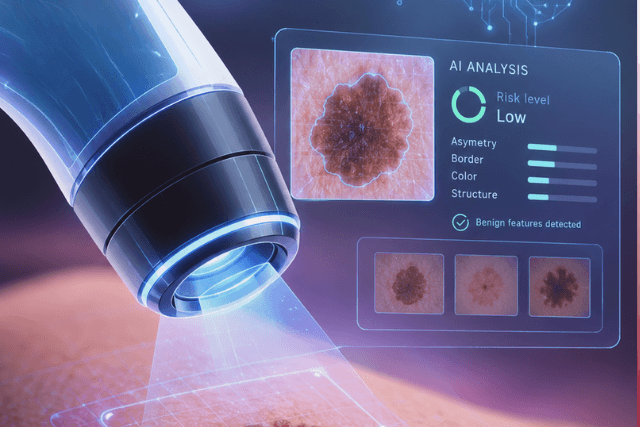
(Vienna, Austria, Wednesday, 30 September 2026) A real-world study of 8,391 patients found that autonomous artificial intelligence (AI) could free up enough clinical capacity to provide more than 8,500 additional face-to-face dermatology appointments across two UK hospitals over 16 months.
The findings, presented today at the European Academy of Dermatology and Venereology (EADV) Congress 2026, suggest that an autonomous AI as a medical device (AIaMD) could help address growing pressure on dermatology services. By identifying patients with benign lesions referred on urgent suspected skin cancer pathways, the technology could enable safe management without specialist review, allowing dermatologists to focus their expertise on patients who need it most.
Urgent suspected skin cancer referrals in England have almost tripled since 2009, yet around only 6% result in an urgent skin cancer diagnosis. At the same time, approximately one in four dermatologist roles in the UK is unfilled, creating a growing imbalance between demand and specialist capacity.
The autonomous AI-supported pathway managed 8,391 patients, representing 94% of urgent suspected skin cancer referrals across the two hospitals. Overall, 86% of patients consented to autonomous decision-making. According to the researchers, this represents the first large-scale dataset from a prospective realworld deployment of autonomous AI within a cancer pathway.