

Session type: Focus on
- Thursday, 7 May
- 14:00 - 15:30 EEST
Trichoscopy of non-cicatricial alopecia
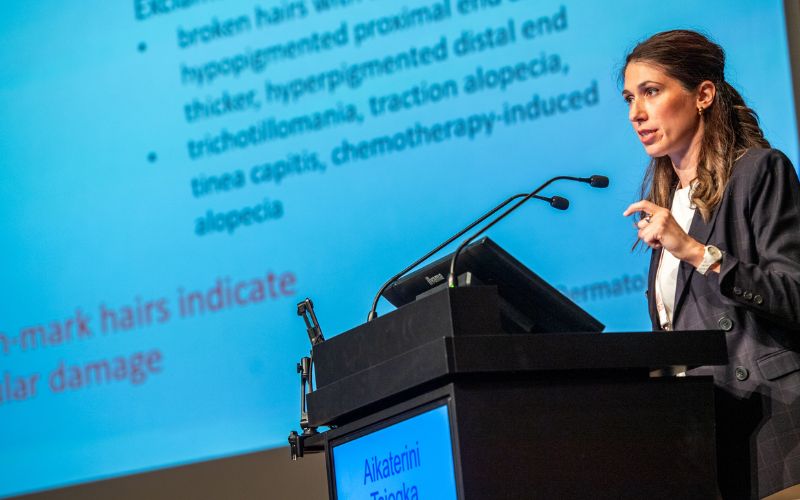
Dr. Aikaterini Tsiogka (Athens, Greece) opened the session with an update on non-cicatricial alopecia, a common type of hair loss where hair follicles are preserved. This characteristic makes it a potentially reversible condition and underscores the need for early diagnosis and treatment initiation.
Dr. Tsiogka highlighted that trichoscopy is the best, non-invasive tool for enabling detailed visualisation of the scalp and hair follicles, monitoring activity and importantly, treatment efficacy. A three-step algorithm has been developed to diagnose and differentiate between alopecia subtypes, which combines clinical and trichoscopic findings with pattern analysis based on distribution, scarring or non-scarring, with trichoscopic clues and patterns.
Using the algorithm, Dr. Tsiogka highlighted the unique features of each of the non-cicatricial alopecias but noted that, in most cases, there is no single pathognomonic diagnostic trichoscopic finding for each subtype. Diagnosis should be based on the combination of clinical and trichoscopic findings.
Drug-induced hair loss
Prof. Alexander Katoulis (Athens, Greece) highlighted that drug-induced hair loss is a relatively common and under-recognised cause of alopecia, which is usually reversible without permanent follicular damage.
Typically presenting as diffuse, non-scarring hair loss, the clinical presentation and severity is dependent on the causative agent’s mechanism of action. He reiterated that a wide range of medications may be implicated, which represent the ‘great imitator’ in modern medicine with the ability to reproduce diverse alopecia phenotypes, with non-scarring and rarely permanent or scarring forms, complicating diagnosis.
Prof. Katoulis underlined that a detailed drug history of any new medications or previous drug exposure, with temporal association, are critical for an accurate diagnosis. While oncological, cardiovascular, endocrine/hormonal and neurological/psychiatric medications are often implicated, dermatological medications may also be a cause. Management focuses on identifying and withdrawing/substituting the causative agent, with reassurance and support to lessen the psychosocial impact.
“Today we have many treatments – diagnosis is key.”
Topical treatments in adrogenetic alopecia
Prof. Asja Prohić (Sarajevo, Bosnia and Herzegovina) gave an overview of current and emerging therapies for androgenetic alopecia (AGA).
AGA represents the most common form of progressive hair loss in clinical practice, affecting both sexes, with a pathogenesis based on androgens and genetic predisposition. The hallmark characteristic is follicle miniaturisation. Treatment goals are to slow or halt hair loss, with acceptable hair regrowth, and improve quality of life through individualised treatment.
Prof. Prohić highlighted that to date, only minoxidil is licensed for use in AGA, while other medications being used off-label are very effective. The topical therapies, minoxidil and finasteride, remain the cornerstone of AGA treatment. Topical antiandrogens, such as clascoterone and pyrilutamide are emerging targeted options. Other agents, including dutasteride (available in an injectable form) show promise but with variable results. Different combinations and approaches (e.g. microneedling and exosomes) have also been used, which may enhance treatment outcomes. Personalised treatment is key for optimal long-term results.
“Shedding experienced at the beginning of treatment is a positive sign.”
Systemic treatments in alopecia areata
Prof. Lidia Rudnicka (Warsaw, Poland) summarised why, when and how to use systemic therapy for alopecia areata (AA).
There are several systemic aspects to AA, affecting hair at different sites and the nails. Blood analysis is key as proinflammatory cytokines are related to disease severity and can lead to vascular disease. There is an increased risk of insulin resistance, diabetes and cardiovascular disease in patients with AA.
Recent consensus recommends that treatment should be initiated as early as possible to increase the probability of reversal. Shorter disease duration and lower SALT score are related to response to treatment and hair growth.
Prof. Rudnicka noted that corticosteroids have been used for many years. They are recommended for first-line treatment for acute AA owing to proven efficacy in a short time period. There is currently no consensus on which agent (e.g. prednisone, dexamethasone, triamcinolone) should be used from a lack of clinical trials.
For non-acute forms, the JAK inhibitors, baricitinib (adults) or ritlecitinib (children >12 years) are approved for use in Europe and have shown efficacy in terms of treatment response after three years. If these medications are not possible/contraindicated, cyclosoprine, followed by methotrexate or azathioprine, in combination with corticosteroids, are possible alternatives. Oral minoxidil may also be added as adjuvant therapy.
Key takeaways
- Diagnosis of non-cicatricial alopecia subtypes should be based on evaluation of clinical and trichoscopic findings.
- Drug-induced hair loss is an under-recognised cause of alopecia with a severe psychological impact.
- Topical minoxidil and finasteride remain the cornerstone of AGA treatment.
- Corticosteroids or JAK inhibitors are effective treatments for AA.