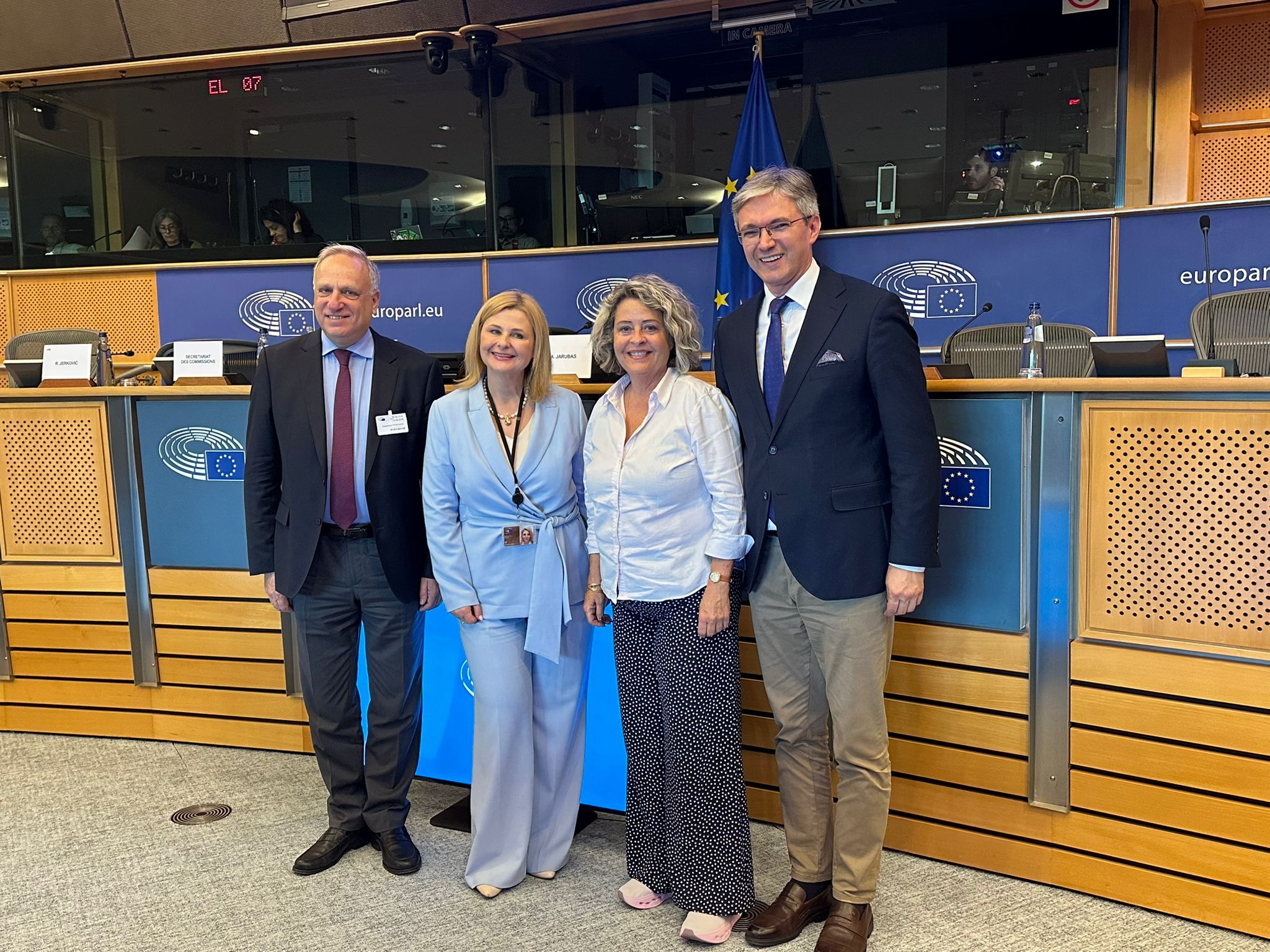
On 3 June 2026, the Committee on Public Health (SANT) of the European Parliament held an Exchange of Views on the prevention of skin diseases and the public health risks associated with sunbed use. The session featured interventions from two members of the European Academy of Dermatology and Venereology’s Advocacy Taskforce: Prof. Alexander Stratigos, Professor at the Department of Dermatology-Venereology at the University of Athens Medical School, former EADV President, and Prof. Aleksandra Lesiak, Professor of Dermatology at the Medical University of Lodz.
This Exchange of Views was a historic milestone for skin health at EU level, marking the first European Parliament session dedicated specifically to skin disease prevention and the public health risks of sunbed use.
The session was chaired by the Member of the European Parliament (MEP) Adam Jarubas (European People’s Party, Poland), Chair of the SANT Committee, and MEP Stine Bosse (Renew, Denmark), who shared a personal testimony as a former sunbed user and melanoma survivor.
Key Takeaways: Skin Diseases deserve a central role in EU health policy
The Exchange of Views reinforced that skin diseases deserve a central place in EU health policy, and that the political momentum to act exists. EADV calls on EU institutions and Member States to build on the outcomes of the Exchange and translate this commitment into concrete action:
- Recognise skin diseases as a major public health challenge requiring coordinated EU action
- Introduce an EU-wide ban on sunbed use for minors and ensure proper enforcement
- Urge the European Commission to resume its work on the Recommendation on UV radiation from sunbeds
- Introduce comprehensive legislation to ensure sunbed safety and compliance, including restrictions on advertising, particularly on social media
- Promote prevention and awareness initiatives on the skin cancer risks of sunbeds, particularly targeting high-risk groups
- Ensure that chronic inflammatory skin diseases are recognised as cardiovascular risk factors in EU cardiovascular policies and screening protocols
- Integrate mental health support and stigma-reduction measures into skin disease care pathways
- Address the disproportionate burden of skin diseases on women through gender-sensitive research, prevention and care
- Strengthen support for rare skin diseases, including long-term funding for the European Reference Network for rare skin diseases and integration into the European Health Data Space
Key remarks from the experts
Prof. Alexander Stratigos showed how sunbeds emit UV radiation up to 15 times higher than the sun at peak intensity. This UV radiation is classified by the International Agency for Research on Cancer as a Group 1 carcinogen, the same category as tobacco and asbestos, and both the World Health Organisation and the European Commission’s Scientific Committee on Health, Environmental and Emerging Risks (SCHEER) concluded that there is no safe limit for UV radiation from sunbeds.
Prof. Stratigos noted that skin cancer is now the most common cancer worldwide, with over 150,000 melanoma cases diagnosed annually in Europe alone, with indoor tanning significantly increasing risk. Risks of sunbed use are particularly severe for young people and women: individuals using sunbeds before the age of 35 increase their melanoma risk by 75%. In a study of 63 women diagnosed with melanoma before age 30, 97% had used tanning beds. He further highlighted the fragmented EU regulatory landscape: while 17 Member States have bans for minors, 10 have none, with compliance weak even where bans exist.
Prof. Stratigos called for stronger and more coordinated action at both the EU and national level to reduce the public health risks associated with sunbed use. He urged MEPs to liaise with national governments and parliaments to ensure that all Member States introduce bans on sunbed use for minors, while also supporting amendments in the European Parliament’s own-initiative report on Europe’s Beating Cancer Plan calling for an EU-wide ban.
He also urged MEPs to press the Commission to resume work on its planned Recommendation on sunbed use, calling for comprehensive legislation to strengthen sunbed safety and compliance, including restrictions on advertising and social media promotion, alongside prevention and awareness initiatives targeted at high-risk groups.
“This is not time a time for policy retreat, this is a time to renew action”
Prof. Aleksandra Lesiak focused on the broader public health burden of skin diseases and their intersection with cardiovascular health, mental health, women’s health and rare diseases. She stressed that skin diseases are not cosmetic conditions, but chronic and systemic diseases, with physical, psychological and social consequences for millions of Europeans. She recalled that almost half of all adult Europeans – around 185 million people – live with at least one skin disease, yet these conditions remain persistently underestimated in EU health policy, with consequences for funding, research and access to care.
She highlighted that chronic inflammatory skin diseases are systemic conditions driven by inflammatory mechanisms that also affect blood vessels and the heart. Early and effective treatment of inflammatory skin diseases can reduce cardiovascular risk. Referring to the Commission’s forthcoming Council Recommendation on Cardiovascular Health Checks, she argued that chronic inflammatory skin diseases should be recognised as cardiovascular risk factors, and that their diagnosis should systematically trigger cardiovascular risk assessment.
Prof. Lesiak underlined the mental health burden of skin diseases, stressing that the visibility of skin conditions has consequences that go far beyond physical symptoms. 88% of people with a skin disease considered their condition embarrassing in their personal life and 83% in their professional life, while almost one in four had changed professional activity because of their condition. She called for mental health support to become a standard component of skin disease care pathways at EU and national level.
Prof. Lesiak also stressed that skin diseases do not affect men and women equally, noting that women are disproportionately affected by several prevalent and stigmatising skin conditions, including atopic dermatitis and adult acne, and that women with psoriasis have a higher risk of ischaemic stroke than men with psoriasis. She called for the EU Gender Equality Strategy 2026–2030 to address research gaps on hormonal drivers of skin diseases.
Finally, she highlighted the burden of rare skin diseases, noting that over 1,000 rare skin diseases are known and that the skin is one of the organs most frequently affected by rare diseases. She called for stronger and more stable support for European Reference Network for rare skin diseases, including long-term funding beyond 2027, stronger integration into national health systems, and the integration of rare skin disease registries into the European Health Data Space.
“Almost half of all adult Europeans, over 185 million people, live with at least one skin disease. Yet skin diseases are systematically underestimated in health policy and too often dismissed as cosmetic conditions.”
You can access the full recording at this link.
Q&A session
MEP Adam Jarubas (EPP, Poland), Chair of the SANT Committee, welcomed the expert contributions and positioned the discussion as an opportunity to consider how skin health can be better reflected in EU public health policy and the European Parliament’s work.
MEP Stine Bosse (Renew, Denmark) shared her personal experience as a former sunbed user and melanoma survivor. She highlighted the social and cultural pressures, particularly social media’s association of tanned skin with attractiveness, that continue to drive tanning behaviours among younger generations. She also expressed support for continued investment in European Reference Networks.
“As a former sunbed user and melanoma survivor, I know how important it is to communicate the risks of tanning in a way that resonates with people, especially young people exposed to social media pressure and beauty standards”
Both experts agreed that the message should not be to avoid the sun entirely, rather to promote moderate and protected exposure, while clearly distinguishing natural sunlight from sunbeds.
Conclusion
This Exchange of Views made clear that skin health must be integrated into current EU health initiatives, including on cancer prevention, cardiovascular health, women’s health, rare diseases, and mental health. It is essential that the evidence presented during the session is reflected in future parliamentary work and Commission initiatives.
The session also reinforced the need to maintain political momentum on sunbed regulation and skin cancer prevention. In particular, the evidence presented on artificial UV exposure, the fragmented regulatory landscape across Member States, and the need for prevention and education among young people point to clear opportunities for further EU-level engagement.
EADV thanks the SANT Committee for hosting the Exchange of Views and for enabling a constructive discussion with MEPs. Building on this dialogue, EADV looks forward to continuing to support policymakers with scientific expertise and policy input to strengthen prevention, early detection, awareness and coordinated action on skin health across Europe.