Session type: Focus on
- Saturday, 9 May
- 09:00 - 10:30 EEST
Malignant skin tumours
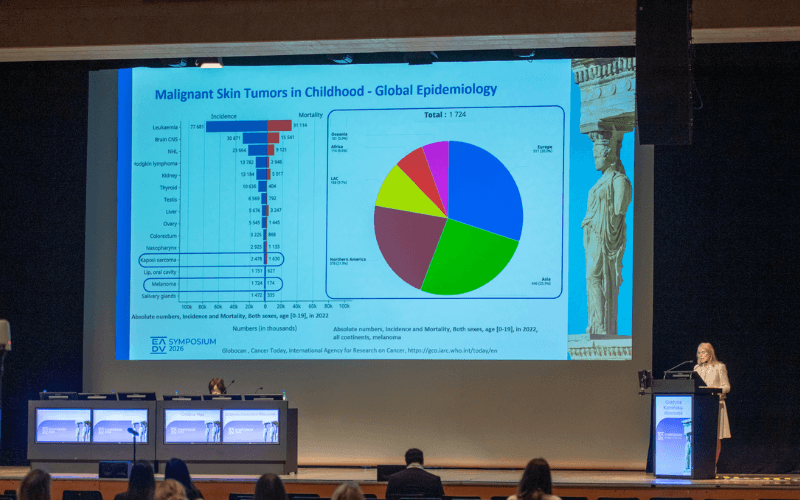
Prof. Grażyna Kamińska-Winciorek (Gliwice, Poland) opened the session by highlighting that although paediatric cutaneous malignancies are rare before puberty, they are often aggressive and biologically distinct from those in adults.
Leukaemia, brain and central nervous (CNS) tumours and Hodgkin/non-Hodgkin lymphomas have the highest incidence, while Kaposi sarcoma (predominant in Africa) and melanoma (all continents) are lower. Clinical warning signs for melanoma include rapid growth, diameter >3 cm, firmness on palpation, ulceration and adhesion in the neonatal period. If in doubt, the lesion should be biopsied together with a differential diagnosis and medical history to determine risk.
Prof. Kamińska-Winciorek highlighted that melanoma in children may not follow the typical ABCDE classification, and that additional criteria (ABBCDDE) should be used. There are distinct differences between children and adolescents and dermoscopy is fundamental for differentiation (i.e. Spitz naevus vs Spitz melanoma). Naevus-associated melanoma accounts for ~40% of all cases. High-risk conditions such as congenital melanocytic naevus, epidermolysis bullosa and vascular neoplasms require lifelong vigilance. Early recognition and treatment, careful surveillance, and multidisciplinary care are essential for improving melanoma outcomes and save lives.
Genodermatoses evolving into adulthood
Dr. Pablo Lopez Balboa (London, United Kingdom) took the participants on a journey of developments in genodermatoses through the ages.
First described as a fish-scaled dermatosis that does not sweat in 200-300 BC, it was many decades later before ichthyosis was recognised as a congenital condition. Developments over the last 200 years, including chromosome visualisation and the discovery of DNA have enabled greater understanding, with important changes since 2005, namely next-generation sequencing (NGS), whole exome sequencing and genome editing.
Over 700 inherited skin disorders caused by pathogenic variants have been identified. Between 2009–2019, NGS enabled identification of 166 new disease-gene associations, leading to new diagnoses and classification and a better understanding of genotype patterns (i.e. epidermal differentiation disorders in adolescents). Advances have also improved knowledge of pigmented cases and classification of inherited fragile skin disorders (i.e. epidermolysis bullosa [EB]). EB has distinct phases throughout life and treatments are available in children and adults, including novel vehicles and gene silencing.
Dr. Balboa remarked that perhaps the most exciting development, which uses CRISPR technology, has the capability to change mutations directly through base editing or priming.
“There is a bright future ahead of us in genodermatosis… maybe in the future we’ll be able to have a genetic diagnosis and with just one injection we’ll be able to cure most of these patients.”
The lifelong consequences of vascular anomalies
Prof. Teresa Oranges (Florence, Italy) gave an insightful overview of vascular anomalies illustrated with photographs of case studies.
The classification has been recently revised to include two main groups: vascular tumours and vascular malformations. Both have severe life-long consequences and can be part of complex syndromic diseases. Treatments are functional, psychological and aesthetic to improve quality of life (QoL).
Infantile haemangioma is the most common benign vascular tumour and is associated with severe consequences. It starts with a proliferative phase, which then plateaus. Some cases should be treated with oral propranolol to reduce functional/aesthetic risk or to relieve pain. Patients with a port-wine stain should be screened for Sturge Weber syndrome for brain or eye involvement.
Vascular anomalies are associated with bleeding, ulceration, pain, thrombophlebitis and functional impairmentcomplications and a low QoL, with adolscents reporting significantly worse physical functioning than younger children, particularly where the tongue is involved. For Klippel Trenaunay syndrome, alleviating functional impairment is key. PROS, an overgrowth condition caused by a gene variant, can present as CLOVES syndrome, which may be improved with sirolimus and alpelisib.
Preventive strategies in childhood to avoid diseases as adults
Dr. María Dolores Mendoza Cembranos (Madrid, Spain) highlighted that prevention should start in childhood as many adult health outcomes are shaped in early years.
The environment is important, and limiting exposure to UV radiation, extreme temperatures, pollution and microplastics is essential to reduce atopic flares. Evidence shows that early sun protection and healthy habits prevent future skin diseases. In addition, appropriate early-life exposure to allergens (e.g. peanut consumption in early life) modulates risk. There is strong evidence to treat eczema as early as possible before it worsens.
Balanced nutrition with physical activity, adequate sleep, and avoidance of tobacco are fundamental to good skin health and reduce flares. Adoption of a Mediterranean diet has been associated with improving psoriasis.
Dr. Mendoza underlined that mental well-being and skin health are closely linked, with poor mental health, body dysmorphia and suicidality associated with chronic skin disorders. Responsible screen time and social media use are neededwith a holistic, educational approach. Small early interventions can have a major long-term impact.
Key takeaways
- Early diagnosis is fundamental to improving melanoma outcomes.
- Base editing or priming technology may enable precision medicine for genodermatosis.
- Vascular anomalies have been recently classified to include vascular tumours and vascular malformations.
- Strategies initiated in early childhood prevent dermatological diseases in later life.