Session type: What's new
- Friday, 8 May
- 9:00 - 10:30 EEST
- Trianti Hall
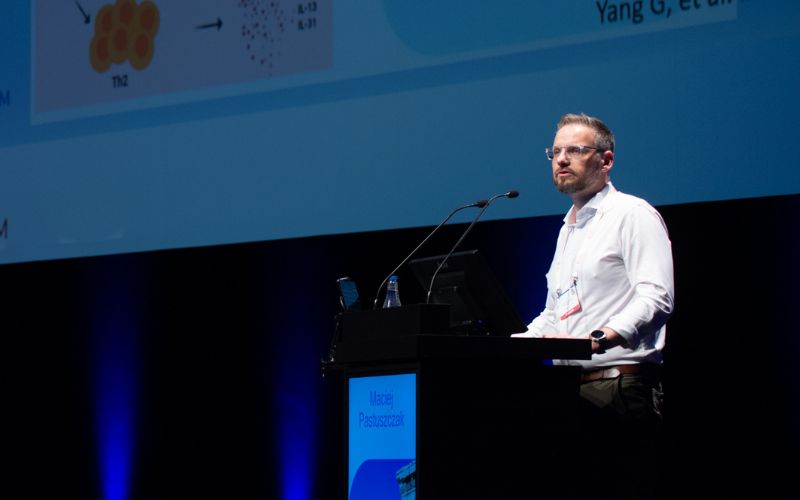
Pathogenesis and endotypes
Prof. Maciej Pastuszczak (Zabrze, Poland) opened the session with an insightful overview of pathogenesis and relevant endotypes in atopic dermatitis (AD).
AD is not a single disease. Clinical heterogeneity represents a spectrum of different underlying molecular endotypes, which can lead to variations in treatment response. Currently, there is an efficacy gap in matching appropriate therapy to the specific biological driver.
Pathology is driven by distinct immune and barrier pathways. However, different endotypes may evolve or mix, changing from a classical Th2 endotype to Th2/TH17 or Th22, a non-immunoglobulin (Ig) E endotype, or a filaggrin mutation. Endotypes can shift over time, and age-related forms may impact treatment response. There is also phenotypic divergence between individuals of African and Asian descent, and skin microbiome dynamics of commensal organisms, exerting pathogenic dysbiotic or protective effects.
Prof. Pastuszczak emphasised that a traditional, uniform-therapy approach is insufficient and that treating phenotypic and endotypic heterogeneity requires precision. Predictive markers may enable the use of appropriate targeted therapy (e.g. Th2/Th22 inhibitors, anti-CCL22 agents and IL-5 inhibitors). As treatment response reflects the underlying biology in AD, non-responders represent a need for alternative pathway suppression.
“The future could be molecular endotyping because this may enable us to stratify the immunologic pathogenesis of AD in every patient.”

Lifestyle, prevention and disease modification
Prof. Mette Sondergaard Deleuran (Aarhus, Denmark) gave important insights on different factors impacting AD.
Lifestyle factors (skin hydration, bathing, clothing, stress and sleep quality) have an important role in AD. Daily moisturisation is the most important preventive measure, and maintaining an acidic pH improves skin barrier function. Environmental factors are also key, with avoidance of personal triggers, smoke or extreme temperatures and control of humidity and dust mite/animal dander exposure indoors. While mental health issues are often overlooked, therapeutic education can have a positive effect.
Prof. Sondergaard Deleuran noted that disease modification is essential. AD has a high disease burden and individuals can feel stigmatised, leading to psychological damage even if the skin is healed. Early, effective treatment when AD signs and symptoms first appear reduces flares and may modify progression. Importantly, proactive treatment reduces inflammation to subclinical levels.
Traditional topical agents are useful as maintenance therapy to reduce relapses and flares. Newer biological therapies (e.g. lebrikizumab, dupilumab) may alter long-term disease course by reducing atopic march and prevent the development of atopic comorbidities. There is a need for more evidence on long-term outcomes, emergence of adverse events and efficacy in young children.
“In my opinion, AD is so much more than just a skin disease.”
Comorbidities: Management and workup
Prof. Stamatis Gregoriou (Athens, Greece) presented the multiple comorbidities associated with AD, which can be atopic or non-atopic.
Atopic comorbidities (e.g. asthma, allergic rhinitis and food allergies) are common in children, and may share an underlying pathogenesis and genetic phenotype with AD. A detailed history is essential to check for atopic march and eosinophilic esophagitis. Management includes targeted therapy, allergen immunotherapy and antihistamines. Immune-related comorbidities (e.g. alopecia areata, vitiligo and contact dermatitis) may also have shared pathways and patch-testing is recommended before initiating biologic therapy.
Prof. Gregoriou highlighted the increased risk of cutaneous infections in AD, which may be extracutaneous and systemic. AD is also associated with increased metabolic, cardiovascular and bone health risk through barrier dysfunction and systemic or chronic inflammation. Smoking is also a trigger, and AD is linked to blood pressure in children. Psychiatric comorbidities have a profound negative impact on productivity and activity.
Appropriate assessment tools should be used to evaluate AD severity and patient-oriented outcomes using multidisciplinary treatment plans. Systemic treatment could have a benefit on systemic inflammation, while approved agents for comorbidities may have holistic effects.
Treatment
Prof. Marie-Aleth Richard (Marseille, France) focused on real-world data of current treatments to provide useful information for daily practice.
Maternal antenatal prebiotic supplementation does not reduce AD incidence or severity in infants. However, early daily emollient use reduces the risk of AD at 2 years with a protective effect in those with no family history of atopic disease.
A 2025 eDelphi study provides useful guidance on how to use methotrexate, including proposed dose and tapering. There is a lot of comparative data on topical treatments; however, direct comparisons are limited. Cochrane and systematic reviews combined with network meta-analyses suggest that potent corticosteroids, tacrolimus and JAK inhibitors (e.g. upadacitinib) are the most effective therapies. Sustained dupilumab is important in the first years of treatment to delay relapses.
Other studies confirm the beneficial effects of targeted systemic therapy (e.g. dupilumab) and immunotherapies on the skin microbiome to reduce S. aureus colonisation and achieve a clinical response. Tolerability data suggest that dupilumab is safe to use in pregnancy and young children, but diagnostic vigilance is required for cutaneous T-cell lymphoma. It is important to individualise risk assessment when prescribing JAK inhibitors to reduce the risk of skin infections, thromboembolism and weight gain in some patients.
Key takeaways
- Phenotypic and endotypic heterogeneity in AD requires precision therapy.
- Newer biological therapies may reduce atopic march and prevent atopic comorbidities.
- Assessment tools should be used to evaluate AD severity using a multidisciplinary approach.
- Potent corticosteroids, tacrolimus, upadacitinib and dupilumab are proven effective therapies for AD.